
It doesn’t have to be a disaster.
What happens if you fall ill while Residential Cruising? Of course it depends on the nature of the illness, where you are, and insurance coverage, but let’s go through a couple of real-world from-our-ship examples.
Sometimes, people die — they can literally be standing there having fun and suddenly collapse, and are dead before they hit the floor. Even if someone does that while visiting a cardiac cath lab with doctors scrubbed up and ready to go, the person just isn’t going to make it. That’s a reality I dealt with many times in my mostly volunteer EMS career: even if I have a defibrillator in my hand and witness them go down doesn’t mean I can get them back. (Though when I did, it was a phenomenal feeling.)
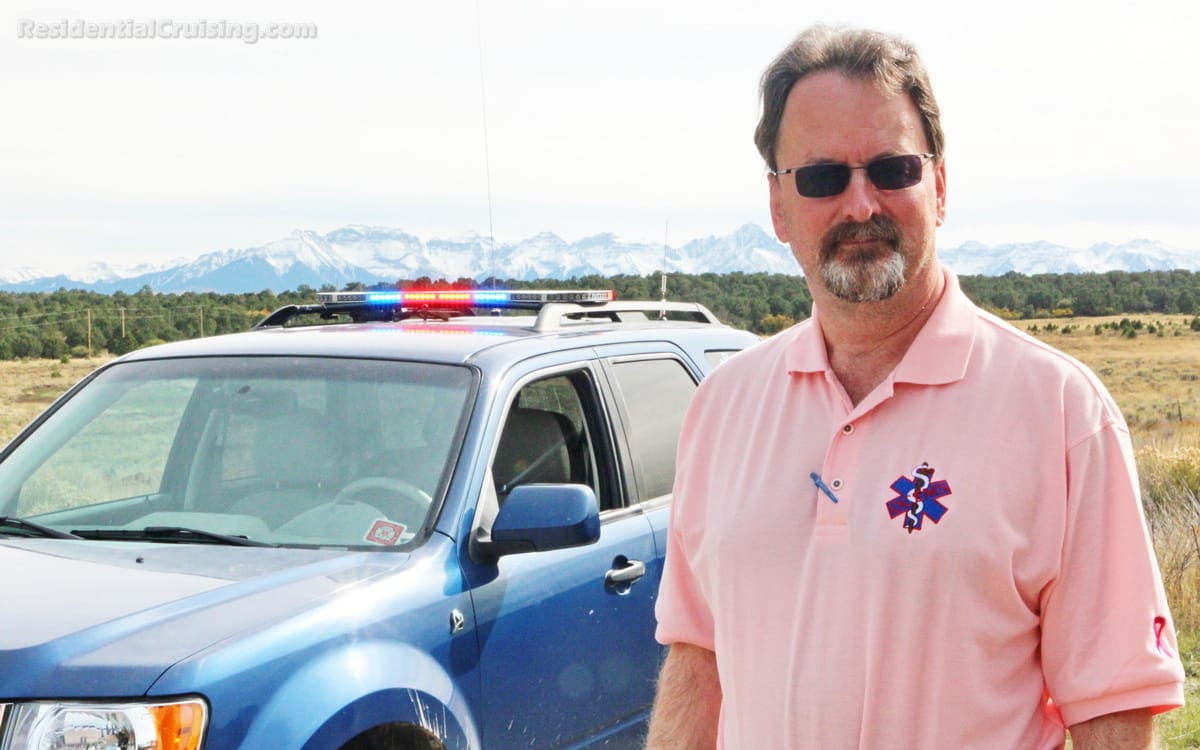
And that very scenario (minus the cath lab or defibrillator) happened on the ship, and he was a wonderful guy and a friend. We were comforted in knowing he was aware of his own medical history and chose where he wanted to spend the rest of his life: circling the globe in the company of friends, some old, many new. We all just wish he had more time.
Usually it’s not that dramatic, of course. For instance, we’ve had several Residents with pneumonia over our now more-than-two-year journey. Yes, they got treatment started in the onboard medical facility, but as soon as there was a more capable hospital available for them, they were transferred out, sometimes by ambulance. That’s something that happens in rural areas across the U.S. every day. I didn’t keep a list, but I think all of them rejoined the ship after they were released.
Basic Care
Not all medical problems are emergencies, of course. Consider routine bloodwork uncovering a problem that needs treatment “soon,” but not “right now.”
The first thing to consider here is “routine bloodwork.” We live on the ship: this isn’t a vacation. We won’t be home in two weeks to get that mole checked or our annual physical, we need to plan for and make time for routine care as we move around the world. Very often, that’s much easier — and cheaper — than getting such care “at home” in the U.S.
The ship’s medical facility offers basic care, and the initial consultation is “free” (part of our monthly fees). It also offers some “wellness” packages, and can even do some limited lab work. But they can’t do many tests that we consider critical, such as thyroid levels and PSA testing, so it’s often best to periodically get ourselves to a fully equipped facility that can do it all when away from your regular doctor.
The real point, of course, is that we do have to pay attention to routine care. We have to stop and get our teeth cleaned now and then, and get physicals. It’s part of life — that “we are not on vacation” part. Ignoring it is foolish, and Kit and I are not foolish.
Just Routine
Kit and I got full physical exams and lab work done in 2024, when the ship was in the U.S. In 2025 we didn’t get physicals, but did get routine bloodwork done, in Panama. All looked good. This year we decided to again get full physicals, and scheduled that for Singapore early this summer. Many hospitals in Asia have packages to choose from with not just blood tests and EKGs, but mammograms, MRI studies, whatever. It’s quite like choosing from a menu. Kit chose one package, I chose another. Both were in the range of US$1,000 — which included lunch afterward!
Lab test results came in after we sailed away. I got an email from the doctor who did mine, wanting to “discuss” the results. I already knew what he wanted to talk about, since they had sent me the lab results and I had already read them. The Panama blood test listed my PSA at 0.92 (“normal” being 0-4). Just 14 months later, Singapore’s PSA result was 13.714 — an increase I found alarming even before the doctor wanted to talk.
We were on the way to Bangkok, Thailand, after stops in Indonesia and Malaysia. A friend had told me of a great hospital in Bangkok, so I sent them a message saying I needed an appointment, mentioning the name of my friend who had been going there for his “medical tourism” for years. I grew anxious when they didn’t reply; I sent another message. Nothing.
I already knew what the next step was: an MRI with contrast to see what’s up in the prostate. I did some research and then sent a message to a different hospital in Bangkok. They replied quickly, and not only set me up with an appointment with a urologist, but reserved a time for an MRI, too.
Nearly a week after everything was set, the first hospital replied asking what I needed. Too late, I replied. Their reputation, for me at least, was ruined — and I relayed that back to my friend.
The second-choice hospital is still top-tier: top-of-the-line equipment, well trained (often in the U.S.) doctors. They of course assign you to doctors who speak your language, or have translators if needed. (Many speak excellent English, obviously including those who studied in the U.S.)
Insurance?
When we set on this journey, Kit and I discussed “What if?” one of us had a “big” medical issue. We’d want international health insurance for acute problems, but thought we would probably go to the U.S. for anything major: we are both covered by Medicare, though we know that U.S. Medicare does not cover us when outside the U.S. (Yes, it’s possible to get expensive “Advantage” plans that do, but rather than buy those, we chose to get health insurance that covers us “anywhere in the world …except the U.S.,” which probably all told costs a lot less. We chose a policy limit of $1 million.)
So a decent insurance policy to help with heart attacks, strokes, whatever, and fly to the U.S. in case of something that needs “a lot” of care, such as cancer. That was our plan.
(Note: I will still write an article about such health insurance, but that needs to wait for another month or so.)
The MRI results were not good: I very likely had cancer. (For those who have been there: a lesion rated PI-RADS 5 — the worst.) Next step: biopsy.
Oh, and by the way, the MRI reading said: that funny feeling I had in my abdomen the past few weeks? That’s a developing inguinal hernia. Total cost for the doctor consultations, the hour-long MRI plus detailed radiology report in perfect English, and misc.? 29,000 baht, or US$870. Imagine what that would have cost in the U.S.! (My guess: at least 10x that, mostly covered by Medicare after they forced the hospital to cut it back to a reasonable amount.)
Now What?
For complicated reasons I chose a different hospital, in Sriracha, Thailand, for the next step: fixing the hernia and getting the biopsy. I notified the insurance company what was up, but in my shock at the diagnosis plus another fact, I failed to get “preauthorization” from the insurance company. “We shall see” if they waive that requirement, but that’s one reason I want to delay my article on health insurance: to see what happens first.
That “other fact”: the consultation with the doctor was on a Tuesday. He agreed the surgeries (biopsy, hernia repair, and one other unrelated problem he uncovered) could be done at the same time — just one round of anesthesia, one recovery, and quicker progress. The only question was “when”. He checked his calendar: “How about Thursday?”
Oh, and they wanted a deposit to cover the expected costs of the surgery, three nights in the hospital, medications, etc.: 330,000 baht, or around US$10,000. That included the three involved surgeons!
That’s right: from consult to lying on the operating table in 48 hours for 10 grand total. Not the typical U.S. “I think we can get you a slot in, oh, about six weeks” — and it’s well into six figures for costs. You get the idea why my friend flies from the U.S. to Thailand for his medical care!
Diagnosis
Biopsy leads to diagnosis: “aggressive” prostate cancer. (For those who have been there: “adenocarcinoma, Gleason score 4+3=7, Grade group 3” in all tested cores.) I had to concede that “aggressive” is right considering the PSA rise from 0.92 to 13.714 in 14 months.
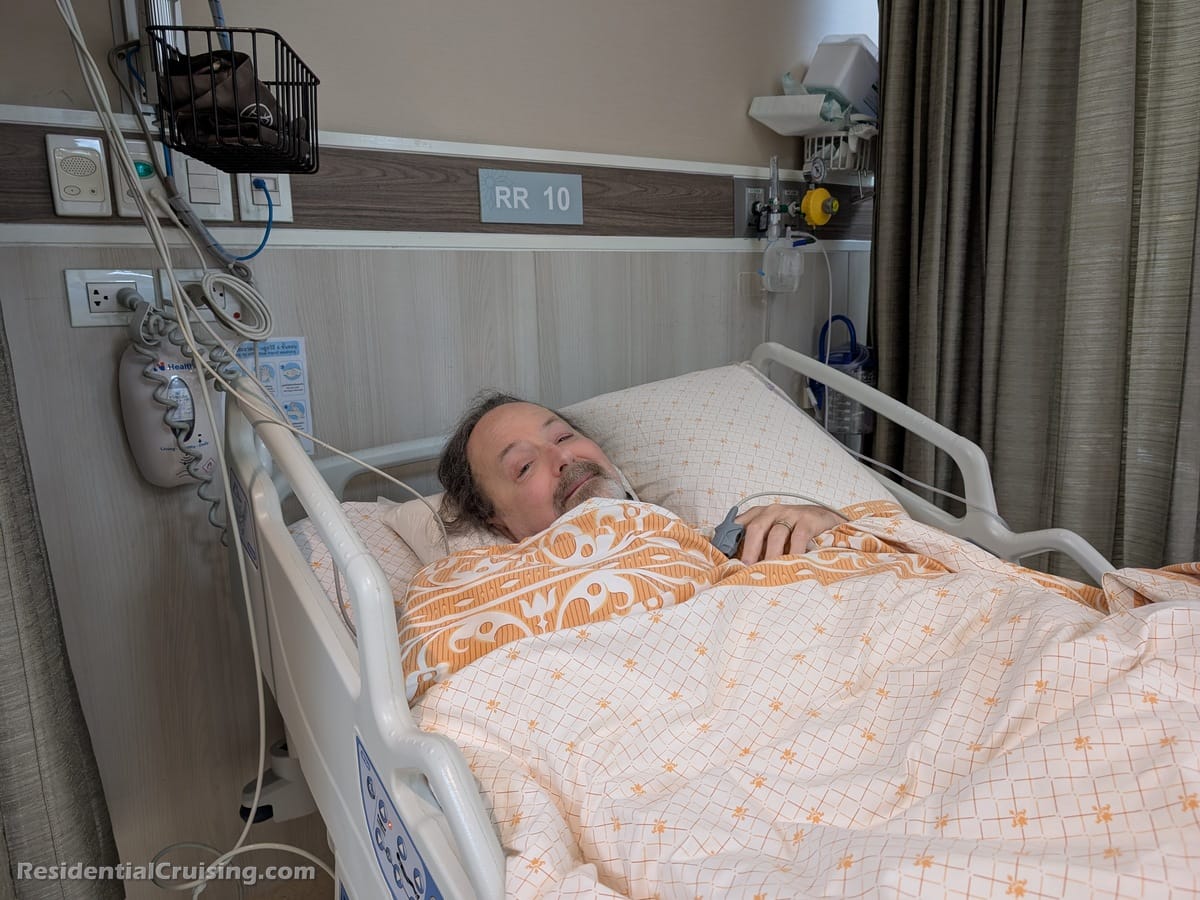
The next step was not in quite a rush: I needed to heal up from that round of surgeries for a few weeks, and then meet with an oncologist — back in Bangkok — to determine the next steps.
I recovered aboard ship; when it was time to go back to the hospital, we were in Vietnam. I bought tickets back to Thailand. Things moved quickly again: an appointment with an oncologist who sent me to a radiation oncologist to discuss that option, followed by an appointment with a urology-specialist surgeon to discuss that option. All in a few hours.
The supervising oncologist didn’t offer his opinion as to what was “best” for my situation: both options had the almost exactly same statistical outcome: a 90 percent likelihood of no recurrence in 10 years. He even used the “C word”: “cure.” I chose “SBRT” radiation — a course of just five high-intensity radiation sessions, each followed by a day of rest. In other words, just 10 days!
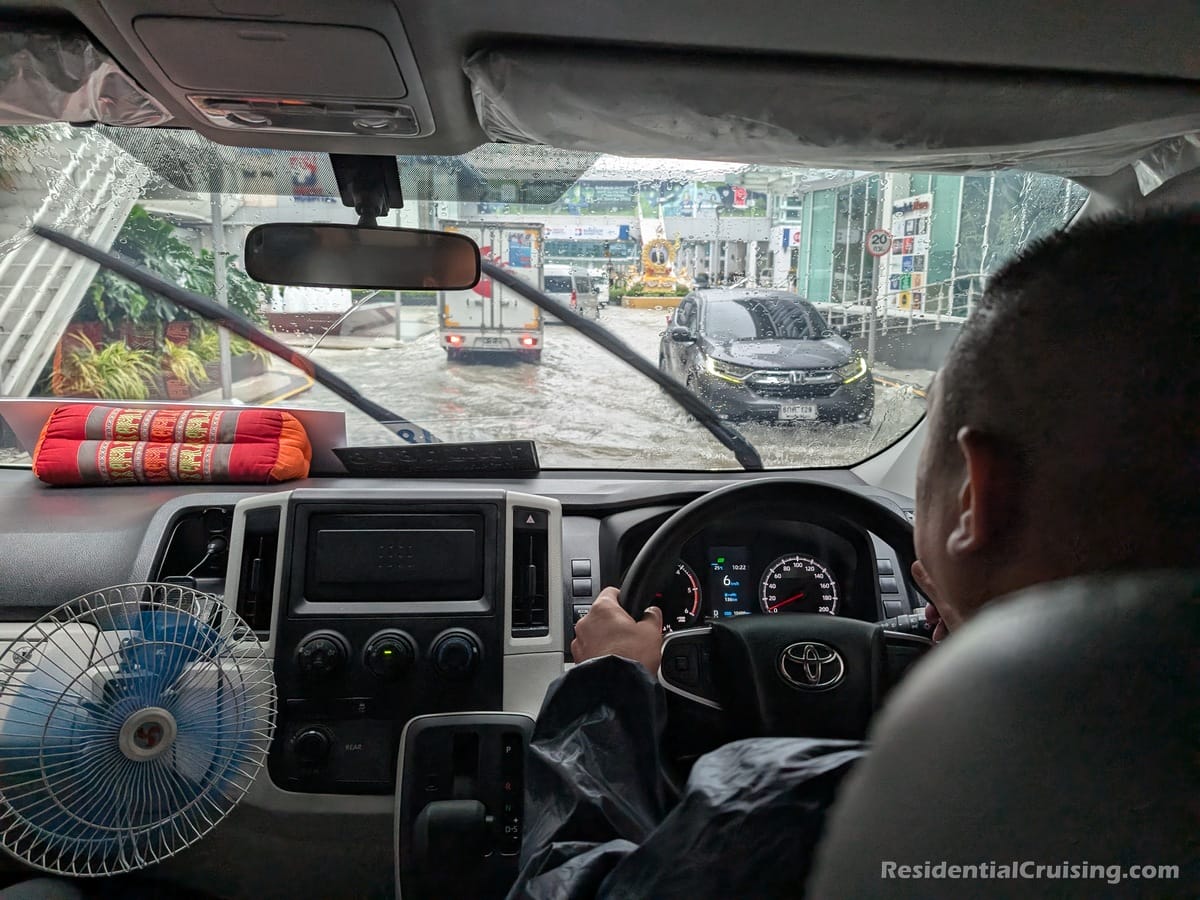
When can we start? Again, 48 hours — before a quick surgery to install “hydrogel” to protect other body structures from the radiation (it’ll dissolve in a couple-few months), then a few days of recovery, and then the treatments could begin.
Meanwhile, the ship continued on to Cambodia, and was scheduled to be back in Thailand as of October 1, then leave again on October 5. “Do you think I’ll be able to get back to the ship before it leaves?” Yes, they said. My last treatment was October 2, and we stayed that night to get some sleep and headed back to the ship on the 3rd.
Home Again
I’ve been greeted again and again with “Welcome home!” from Residents and crew.
I go into all this detail for you to get a full feel for it all: why I chose to disregard “the plan” to return to the U.S. I talked with friends and family about their own prostate cancer experiences, about the waiting and robotic care, and the resulting multi-hundred-thousand-dollar medical bills. The total for all of this for me? Around US$50,000, and much of it is being reimbursed by our insurance (or, for the last phase, paid directly to the hospital), less the $5,000 deductible (or “excess”, as they call it in many other countries).
The only thing not covered: travel costs, including several weeks of hotel stays. But the cool thing is, in Thailand a very nice hotel with a fantastic hot buffet breakfast included (my favorite was the thick, red Panang curry with chicken, over my choice of Basmati or jasmine rice) is around US$65/night. Not to mention avoiding the prospect of $1,000 each way for two of us to fly 30 hours to the U.S., and stay in $150-200/night hotels for a lot longer due to delays in care, with no “let’s go back to the ship for 2 weeks while I heal” in the meantime, all of which would not be covered by Medicare.
Meanwhile, I’m recovering with not all that many side effects (fatigue being the biggest), and I still get to sleep in my own bed. We’re now on the way to Malaysia, Indonesia, Singapore, and other parts of Thailand before heading toward India.
Lessons Learned
We had a plan, and then flexed that plan when it seemed prudent. I’m very happy with the result. Rather than the do-it-and-get-out! care I got for a previous issue that involved surgery, I generally had terrific care in the Thai hospitals.
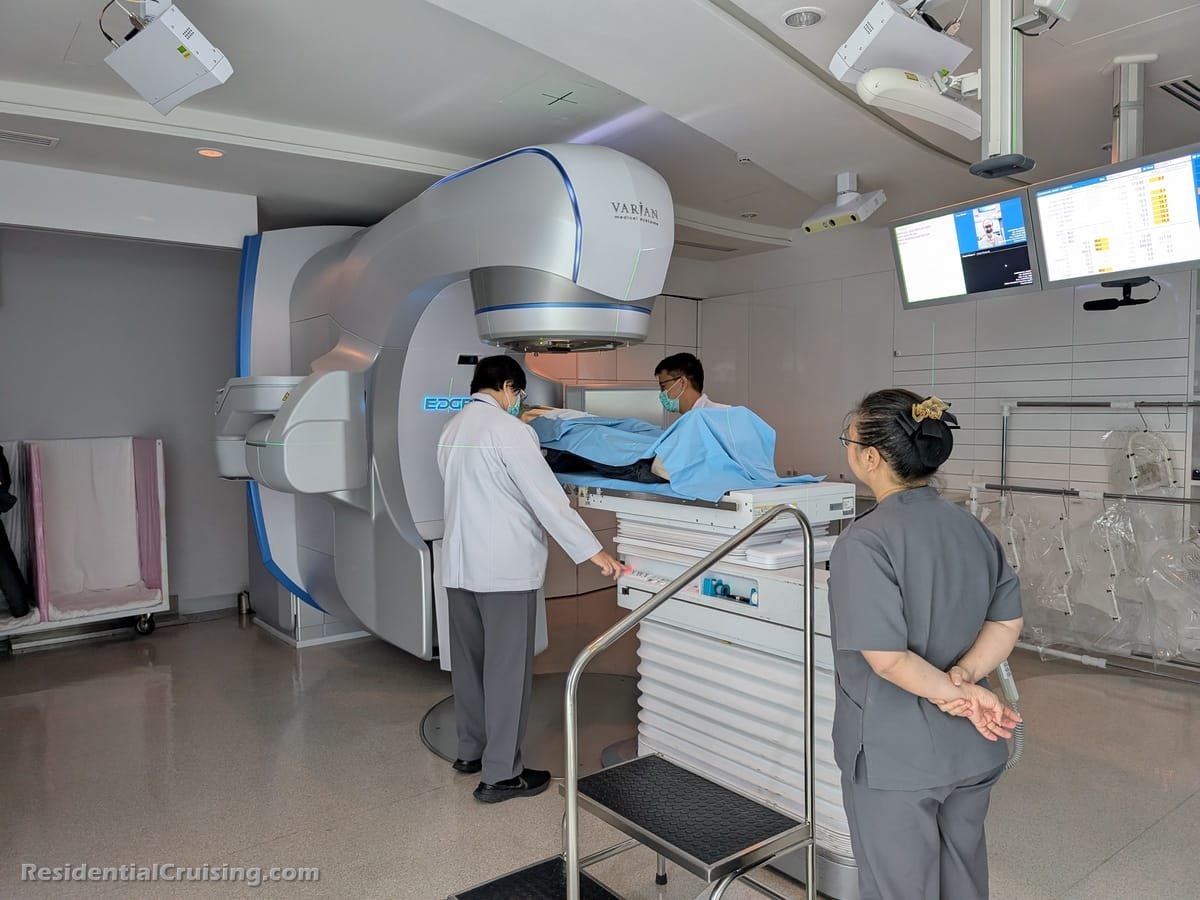
One of my most amusing memories was the sweet gal who was setting me up for my first radiation treatment asking (so she could line me up using lasers pointing at alignment marks drawn on my skin with a Sharpie), “Is it OK if I pull down your underwear?” I don’t think they would have even asked in the U.S. I said sure: there’s not much dignity available in cancer care!
For me the bottom line is, do get insurance if you plan on this lifestyle unless you’re prepared to pay out of pocket. Our policy includes medical evacuation if necessary: they’ll pay for medical transport to the U.S. for care if that’s your choice and it’s “medically necessary.” They’ll probably be glad to do it so they don’t have to pay for your care.
And then, keep up with routine checks, even if you have to pay out of pocket, because that’s a lot cheaper than “flying home” to do it, unless you have specific medical issues that need particular specialists. Either way, it’s something to include in your budget. We did.
And now you know why we haven’t posted any articles for a few months.
- About the Author
- Latest Posts

This is such good news. We hope it stays that way. Having a good plan and bring ready to adjust it paid off. Phew!
Ready to ring that bell, Sir Randy?
(“Ringing the bell in prostate cancer treatment is a symbolic tradition that marks the end of a major phase of care, such as finishing radiation or chemotherapy.”)
—
Huh. Have never heard of that despite having many friends and family ahead of me. But no, I don’t feel like I’m at the end of this yet, with ADT and recovery still to go. -rc
Great article Randy and glad you caught it quickly. This reminded me to get my PSA checked at my next doctor visit.
—
In glad it had that effect — and breast cancer screening too for those at risk, I hope! -rc
So glad you have been treated with dignity, received great care and been able to “remain” home for recovery. Thanks for keeping us updated and encouraged. Praying for strength and rest for you both.
—
Thanks much, Kim. And I gratefully acknowledge you are the (now-deservedly retired) EMS Chief mentioned in the caption of the first photo above! -rc
Kim, it’s great to hear from you. I hope your new life situation is gratifying and joyful.
Wow! I was one of the readers wondering why there were no recent articles. I am so sorry to hear about the reason for your absence, but am happy to hear that you were able to receive treatment quickly and begin recovery.
From the first appearance of the word “prostate” in your article, I knew where it was heading. Even though I’m female, I understood quite a bit about what you were describing (including the Gleason score) because I’ve been helping my friend Alex who has been going through treatment for prostate cancer since 2024. After all that time, he finally was given a clean bill of health from his physician a few months ago.
It’s astonishing to learn that you have been living aboard a cruise ship and still were able to get through the treatment in a much shorter time than someone with Medicare living in the US.
Thank you for posting an article about your experience. While it is focused on seniors living aboard cruise ships, it also will be inspirational to those of us battling the inefficiency of medical care in the US. If you can get faster service while living at sea, we need to get to work improving how health care operates in the US.
—
A very insightful point here! And indeed one of the reasons I made the choice to flex on our “plan”. With an aggressive cancer, I wanted to move more quickly than I could have in the U.S. to increase the odds of a good outcome. Yet it was faster than even I could have hoped. Detection to diagnosis to treatment to release in four months?! Almost impossible with Medicare. And my out of pocket costs will likely be quite a bit less. Truly incredible.
But, of course, it’s not fully over: there’s recovery, side effects, and continuing treatment. I left out the ADT (“hormone treatment”) part, which has its own side effects, including fatigue, which will continue well into next year.
Yes, U.S. healthcare is horribly broken, and this example shows how much better it could be. -rc
That was a very interesting post. And on a very important subject for anyone contemplating or being in an expat life. My wife and I spent 12 years out of the US after retiring, and had to deal with some of the issues you talk about, particularly that Medicare does not take care of you outside the US. Fortunately we were qualified right away to participate in the New Zealand Public Health System. We were always treated very well there.
But for those who have not already done it, there are many important issues to work out and plan for before taking on an expat existence. Healthcare is definitely the biggest aspect of planning.
—
And ignored by far too many! -rc
Wishing you and Kit many years of wellness.
—
You give me a great opportunity to highlight how big a job it is for a partner to support us through a trying diagnosis and treatment! Kit was and still is an absolute rock, by my side the entire time, and continuing! It has deepened our relationship greatly.
There are many singles aboard the ship, and I know of many instances of friends helping others get to, through, and back from hospital care in scary times in foreign countries these past 2 years. It’s just one aspect of Community that’s a big part of living here. I, and I’m sure the others, are very grateful for that support. -rc
Glad to hear the good news. One of the reasons we don’t intend to move back to the US is the great medical care we get in Singapore & Bangkok, much better than what we had while we were living in the US. It’s so much easier (no long waits to get appointments & the doctor is usually punctual), nicer (both staff & hospital/clinic settings), & cheaper.
—
And, readers may be surprised to hear, unhurried: we can ask questions! I had a long, written list for my oncologists (yes, plural) on the day of my final radiation treatment. -rc
Thank you Arcie. Your story of healing sounds like a “bad news” story followed by a mostly “good news” one. I am happy that you were able to share both. That pesky “aging” thing happens to pretty much all of us! Good luck to you and Kit.
Thinking of you Randy!!! Glad you are recovering and the worst is behind you. Big hugs to you and Kit.
—
Thanks, guys. Stay well. -rc
Good to see you back in your office.
—
Hey! Quit peeking in my window! -rc
Dang—you’re on the healthcare expressway, with an ocean view. Thanks for posting the tale, as it is a useful as an outline of a course of treatment for prostate cancer, regardless of the speed or cost. I am both pleased and annoyed to report that my prostate adventure and the route it followed were much more…pedestrian.
Stay in the well lane.
So good to hear the whole story and that you have passed through the biggest hurdle. Much love and happy adventures to you and Kit.
You’re apparently following me … after my PC treatment, earlier this year I had to have an inguinal hernia repaired. I was actually leaning towards having another robotic repair to install the mesh, but the specialists who do that recommended I have the external mesh repair instead because the prior internal work can leave scar tissue which makes it complicated to go back in.
But I will say that all the staff were friendly and caring.
Glad to hear you’re now well on your recovery journey.
I’m glad you are feeling good about your care. That’s so important. Last year was Dave’s year for the prostate cancer diagnosis. We were fortunate he was able to get all of his care at Walter Reed, and after 28 radiation treatments and a year of oral testosterone blockers, he seems to be doing great.
—
Good to hear! Please pass my good wishes asking to him. -rc
Your story (and others I know) leaves me more convinced than ever how lucky I am to have dodged this particular bullet, as I watched my PSA numbers climb steadily from normal to double digits over the course of the last decade.
High PSA numbers can be caused by prostate cancer, benign prostatic hyperplasia (BPH), or both. Other tools besides PSA are required to diagnose cancer — in my case, needle biopsy, followed by CT scan, followed by MRI. All were inconclusive.
After much research, and many questions for my urologist, I elected to have human-performed HOLEP surgery — Holmium Laser Enucleation of the Prostate. Fascinating tech; the Holmium laser can operate at different power levels depending on whether you want to remove tissue, or cauterize it. It took over 4 hours on the operating table for my urologist to remove 90% of my 200+ gram grapefruit-sized prostate. The removed tissue tested cancer free. It wasn’t until then that I knew for sure, and my post-op PSA numbers are back within normal range. Also can finally pee normally again with an unconstricted urethra.
The radiation treatment sounds like the right choice — avoid the experience of having a 3-way Foley catheter installed inside you.
—
Very interesting indeed, and a good reminder that a PSA increase doesn’t always mean cancer. Glad you’re on the mend, Bill. -rc
My husband just went through the same process here in the States; specifically Portland OR. Same procedures only with LINAC rather than SBRT. He finished his in JAN and have had two PSA’s since then; both of which his Doc has been very happy with. We have an appointment on the 23rd of this month to go over all and it is looking very good for the procedure he had done.
We have a friend who has had rising PSAs for the past 9 years been told that his doc just wanted to wait and see on his prostate cancer by monitoring it. It took an aggressive turn this past 6 months and it has now Metastasized. Our take — treat prostate cancer aggressively from “day 1”.
Take care, we wish the best for you AND Kit!!
—
Great result for your husband, terrible for your friend, and exactly why I moved quickly on mine. -rc
We haven’t met yet, but I’m on the Odyssey as well since late July.
I had cataract surgery on both eyes in Vietnam a few weeks ago and it cost me a whopping $2,200 all in. I think I’ll be getting all of my medical needs taken care of in Southeast Asia.
—
Wow! And obviously you are pleased with the results. Stop by and say Hi sometime: I’m in the corner office. -rc
I recently had a kidney biopsy done at my local hospital and my share of the costs AFTER insurance paid (been told we have Cadillac health insurance) was $788! You got a great deal!
Wow that is quite a story. So glad you found it and have alleviated the cancer. Heal well my friend and please share more of your experience as you heal. Personal regards.
It’s annoying to be slapped in the face with the fact that good, reasonably priced AND FAST medical care is easier to find outside the US than inside.
Exactly. I’ve had friends who drove to Tijuana for medical treatment. Tijuana!!!
—
Yes, but remember that the U.S. healthcare system is unique: it alone in the world is not about treating the sick and injured, it’s about allowing huge corporations to extract money to enrich shareholders. It’s an absolutely sick situation and of course we’ve gotten to the point where other countries provide much better care at much lower prices. And, of course, often get much better outcomes. -rc
So happy to hear you sought prompt diagnosis, Randy. We so often hear of cases where procrastination changed the prognosis dramatically for the worse.
As an aside, my daughter is head nurse at a hospital in Tijuana that specializes in cancer treatments, and the cost differentials between Mexico and the U.S. are staggering — as is the speed at which diagnosis and treatment move. It is so sad that a nation like the U.S. still offers only third-world treatment.
—
Just so, Doc. The U.S. used to be a respected leader. Not so much anymore. -rc
So very happy to hear you have gotten superb treatment and are recovering well!!! I have heard such stories before and heard of great insurance coverage outside the U.S. for everywhere, but the U.S. It is a shame, and a sham, the U.S. doesn’t do better. Happy recovery and continued cruising! Much love to you both!
—
Just to be clear, I had an option: “All countries except the U.S.”, and “All countries” — which would have cost much, much more. Since I already have coverage in the U.S. with Medicare, and we’re not scheduled to be in the U.S. for a little over a year, it made no sense to pay that extra. -rc
Barely recognized you without your prostate! Glad to hear you’re on the mend.
—
😂 -rc
We’re Canadians, had a winter place in Texas for a while. In 2022 my wife had a persistent cough, so we went to the hospital our insurance company suggested. The only private space we were in was the office where they confirmed we had insurance. The doctor talked with her in the waiting room, they did a chest x-ray in the hall, and sent us off to get some nonprescription medicine. The bill was $7000!
Also, they contacted us a few times to try to get us to pay, but we ignored them. Canadian Medicare covers a certain amount for procedures out of Canada (basically the amount they pay in Canada), and our out of country pays the rest (which I would assume is a negotiated reduced amount similar to US insurers). If we had paid I suspect getting paid back would have been difficult, and the private insurer probably wouldn’t have wanted to pay the full remainder.
The US system is really an embarrassment, the costs are greatly inflated and insurance is really only available for people with good jobs. And the insurance companies seem to expend a lot of effort trying to avoid coverage.
But I’m happy to hear that you’re on the mend and appear to have a good chance at a positive outcome.
Also, I’m really jealous of all the places you’ve been getting to visit.
Best wishes.
Good to hear you’re well. Hope they got it all and you’re now cancer-free.
What an ordeal! I’m glad you found good medical help, and hope you heal and recover your strength quickly.
When I met you and Kit outside the morning light a few weeks ago, you mentioned that you had hernia surgery. At the time, I was thinking I wonder if there’s more to it but, polite Canadian here, would never ask. My intuitive nudge knew you would mention it, or not, in your own time. It sounds like your medical care from diagnosis through treatment is very well choreographed. The fact that the doctor actually used the cure word is extremely reassuring. Also, your description of Kit being so attentive, your strong rock, does not surprise me at all. It’s in her hard wiring as she has also shown care and compassion to other members of our ship family. I am also confident that if the roles were reversed, you would be her strong rock as well.
All the best to you as you move forward through your healing to a wonderful outcome. 🪨❤️🔔🛳️!!
—
Pam, all Canadians are welcome to ask questions: I know you’ll be polite about it! 🙂
But more seriously, with so many folks onboard being friends, I can’t keep track of who we’ve told what, so it’s always OK to go to the source if you hear a rumor, or are concerned. Really. -rc
Wow, what an unexpected added adventure for you and Kit! I choose those words advisedly: I’m not making light of your situation in the least, but knowing Kit as I do, and her uber-positive attitude (and now that this is all in your rear view mirror)…just wow. Thank you for sharing all this with us; what a story, and useful information for anyone considering your lifestyle. You and Kit are in my thoughts and prayers. Heal well! 🙏❤️
—
Indeed my intention, starting with the title. It IS a reasonable concern, and we had it too. We had insurance start the day we left the U.S., but could we get good care? The answer has been a resounding yes. Kit even did the research and found we’d likely get excellent care in several other places, such as Malaysia. There are options …and, yes, there are places where we would not want to get care also, hence the evacuation component — fly with a doctor to somewhere else for care, whether the U.S. or other appropriate place. “There’s insurance for that” because its cost is high, yet coverage isn’t because it’s fairly rare. -rc
I just got on “for a quick check” and saw your post. 😌 Sounds like a lot of difficult conversations with Kit (((HUGS))). I’m glad you were able to start TX quickly. Words of wisdom from Mark when I was going through chemo: If you think a bag of cheetos will stay down, eat a bag of cheetos. Food is fuel and your body needs fuel to FIGHT! Do whatever feels right to you & Kit. There is my unsolicited advice. That and humor therapy helps!!
—
Thanks much: I know you’ve been there! Not really “difficult” discussions with Kit, since we were immediately on the same page. But yeah, I did have a few (Asia-sized) bags of Nacho Cheese Doritos during this, which we could sometimes get in the 7-Eleven attached to the hospital. Even stooped to Burger King once (upstairs from that store). But mainly it was a lot of Thai food, which I really like. 🙂 I gained a little weight during treatment, rather than lose any. (For others, Collette is another of my now-retired medic buddies.) -rc
Glad you caught it and got it treated quickly. I was diagnosed in 2008 and I went to Loma Linda University Medical Center and the James Slater Proton Treatment Center. PSA is now well below 1 and has stayed there since my treatment. Prostate cancer is nothing to put off. I’m thrilled your treatment is working for you. The follow-on hormone treatment can be disheartening but it all beats the alternative.
Here’s to many more years of you trotting ground the globe with your bride. Give her an extra hug. Being the helpless caregiver is not an easy job.
—
While it’s true that prostate cancer “tends to be very slow-growing,” and the patient will typically die of something else (e.g., old age) before the cancer gets to be any real problem, that’s not the case when the patient is barely into Medicare territory — and the diagnosis is “aggressive” cancer, not to mention trying to escape the “capsule”. Make the decision to stay and get on it immediately an easy one. -rc
Thanks for sharing details on your medical journey. I know you must have thought a lot about what to say and not to say before you wrote this. And it is very good to shake up those of us in the US who are inclined to believe our care is “best in the world”. Some of it certainly is but it is such a fight to get to the right place and the right doctor, and the costs are often crippling, even without flying/hotels.
I’m so glad you are well on your way to rachetting down the stress and worry. And a pat on the back for Kit; I know what a “medical spouse” goes through. With your EMS background, the medical terminology is less stupefying and you won’t faint at the sight of blood!
—
You’re perceptive: all is correct. Plus we’re both good researchers, so when we want to know something, such as “How do you deal with THIS bothersome side effect?”, we know both how to describe it to the doctor, ask the right questions, and help evaluate the answer. It’s one of the reasons we’re so chill with the diagnosis and treatment, which is not the same as being blasé about it (we’re not). -rc