
The Sunday Times of London covered the Odyssey again, this time from the angle of affordability.
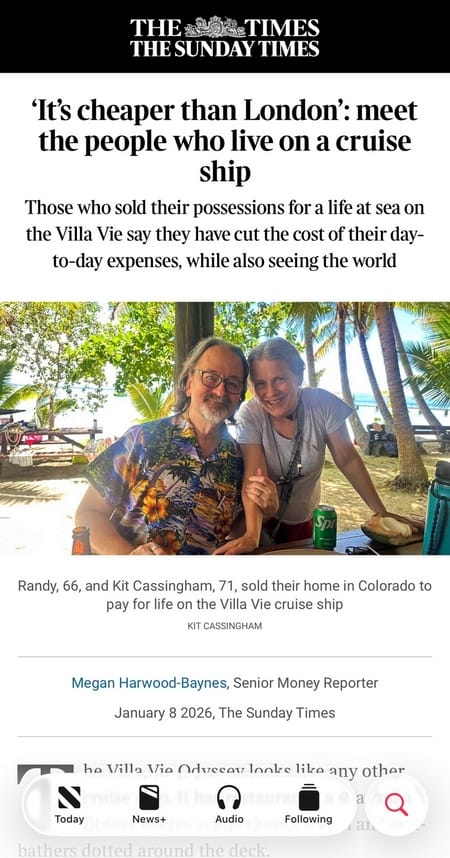
This is True reader Randolph in Canada must’ve received quite the shock when he went to skim through the news and was confronted with a large photo of me and Kit looking back at him. While the story went to print in the Sunday Times (on 11 January), it came out online a few days before that.
It was written by the paper’s very pleasant Senior Money Reporter, Megan Harwood-Baynes, so I knew how to give her the quotes she needed for her beat, such as “‘I’m not coming off this ship alive,’ said Randy Cassingham.” She continued that “Several digital nomads work on the ship, including Randy, who runs a news commentary website that helps to cover the couple’s monthly costs. He has a pension, but has not needed to spend it yet.”
It’s a bit eye-rolling that the Times, unlike most large newspapers in this day and age, Just Won’t Link out to a source’s web site so interested readers can find them. At least one Times reader was intrigued enough that he searched and found the True site and subscribed. How many more would have checked it out if there was a link? Lots. And that’s after I helped her find several other Residents to interview.
The quotes continued, wrapped around a second photo of us:

“Living here is not truly a huge expense. It almost certainly costs less to live here than a flat in London,” he said. “We don’t have a car to pay for. We don’t have a mortgage, property taxes, maintenance, or insurance. We don’t have to shop for groceries. No bills for utilities or internet. We have a predictable monthly expense to be here, another for health insurance, and toiletries and my phone. A little bit if we choose to go on side trips in the countries we go to. So many other expenses are simply gone.”
Links

I’m more generous than the Times’ editor: to read their story, please try first at their site, so it gets clicks to show interest: London Times. If you’re paywalled out, I found it is also available through a free archive.
I’ll also be more generous than U.K.’s LADbible, where the self-proclaimed “NCTJ Gold Standard journalist” James Moorhouse rewrote the Times’ story to feature only Kit and me (no crime there), yet not only also didn’t link to True (rude), but took the time to find this site to steal a copyrighted photo to illustrate it, which is a crime under U.K. law, according to my contact at the Times. The LADs should know better, as well as (as an online publishing site) providing links, as they would want one back.
What could be worse? This: They clipped a tiny bit of a photo of us on CBS News (also grabbed from this site), and labeled that as the credited “featured image” rather than the giant photo of us they put at the top of the page. See below for more on this.
Meanwhile, despite those egregious ethical lapses, I know some of you want to see it anyway, and the right thing to do is provide the link: Couple sold all possessions to live on cruise full time because ‘it’s cheaper than London’.
And that’s how it’s done, LADjerks! 🙂
Related: A list of all known media coverage of Kit/me/this site is on the Media Coverage page.
Addendum: Theft of Intellectual Property
So about that theft of my photo. Here, the day after publishing the page above, seeing that I have already provided LADbible >300 clicks, and finding I’m still bothered by the ethics of the reporter’s theft, I asked ChatGPT what this “gold standard” business is about (I’m not particularly familiar with journalism training in the U.K.), and whether a journalist with such an accreditation could be frowned upon for such an infraction, describing what happened here.
Why? Because I’m going to complain to LADbible about this, and will point the LADbible editor to this page.
Here’s ChatGPT’s response (excerpted but otherwise verbatim, including all emphasis).
In British journalism, “a gold standard NCTJ qualification” means the journalist has completed the most respected, industry-endorsed professional training pathway run by the National Council for the Training of Journalists.
Concretely, it usually refers to passing the full NCTJ Diploma in Journalism with strong results, often including key specialist modules. Newsrooms use the phrase as shorthand for “properly trained to UK newsroom standards.”
[misc. details about what training entails deleted]As for lifting a photo from a source’s web site, a journalist holding a “gold standard” NCTJ qualification is explicitly trained not to do that.
Why this matters under UK journalism standards
Under training set by the National Council for the Training of Journalists, journalists are drilled on two relevant areas:
1. Copyright law
UK copyright is strict. As a rule:
- Photos are protected works
- Taking an image from a copyrighted website and republishing it without permission is infringement
- There is no general “journalistic exemption”
The only plausible defenses are narrow and risky:
- Fair dealing for reporting current events — but images are rarely covered, especially when:
- The photo is not incidental
- The rights holder is the subject
- Permission could reasonably have been sought
- The image is reused as illustration rather than evidence
NCTJ media-law training explicitly warns journalists not to assume fair dealing applies to photos.
2. Professional ethics
Even where the law is arguable, ethics are clearer:
- Using someone’s copyrighted image without permission or credit is considered bad practice
- Editors expect reporters to:
- Request permission
- License stock imagery
- Use agency photos
- Or clearly justify why an image is legally defensible
An NCTJ-trained journalist who does this casually would expect pushback from a competent editor.
How this would look inside a newsroom
If this happened at a reputable UK outlet, typical internal reactions would be:
- “Did you clear the image rights?”
- “Why didn’t you ask — it’s the subject’s own site.”
- “Take it down until we sort permissions.”
If the journalist did it knowingly, that would reflect poor judgment.
If they did it unknowingly, it would reflect failure to apply core training.
The bottom line
Yes — a certified UK journalist absolutely should know better.
What happened to you is not:
- Normal practice
- Defensible by training standards
- Something the NCTJ would endorse
Whether it rises to actionable infringement depends on details (jurisdiction, usage, publication, takedown response), but from a professional standpoint alone, it’s a lapse.
I followed up, asking if “fair dealing” is akin to “fair use” in US copyright law, since my knowledge is much more about US law.
Short answer: no — UK fair dealing is not the equivalent of US fair use. They are related ideas, but fair dealing is far narrower and more rigid.
The core difference
UK: Fair dealing
- Purpose-based and closed
- Use is only allowed for specific, enumerated purposes
- If your use doesn’t fit one of those purposes, it fails immediately — no balancing test
US: Fair use
- Open-ended and flexible
- Any purpose may qualify
- Courts apply a four-factor balancing test to decide case by case
This makes US fair use far broader and more forgiving than UK fair dealing.
What UK “fair dealing” actually allows
Under UK law, fair dealing is limited to uses such as:
- Reporting current events
- Criticism or review
- Quotation
- Parody, caricature, or pastiche
- Research or private study (non-commercial)
And even then:
- The use must be genuinely necessary
- Only the minimum required may be used
- The use must be fair to the rights holder
- Acknowledgement is usually required
Crucially for your situation:
- Images are rarely protected by fair dealing, especially when reused illustratively.
NCTJ media-law training explicitly cautions journalists that photos are the most dangerous category for fair-dealing assumptions.
Bottom line
- Fair dealing ≠ fair use
- UK fair dealing is narrow, specific, and conservative
- Reusing a subject’s website photo without permission is professionally risky and often legally indefensible in the UK
- An NCTJ-trained journalist should know this
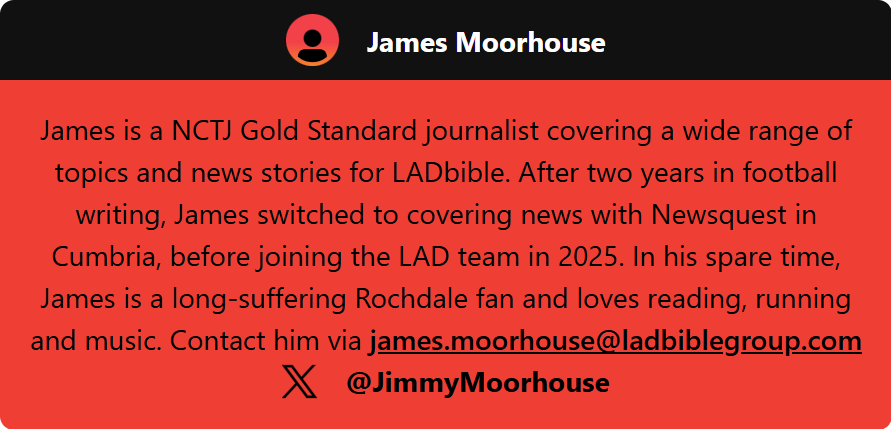
For the record, The Sunday Times of London had explicit permission to use the photos they used in their story. Their reporter politely requested photos, and didn’t simply take them without permission. Appropriate credit was given. And that is why I will complain, in part because the reporter proudly asserts his credibility with this block at the end of the article he illustrated with my property:
I will publish their response in this space. If I don’t get one, I’ll be taking stronger action.
They replied:
Hi Randy,
In response to your complaint, I have removed your photo from the article. I’m sorry that no one reached out to you to request permission.
Thanks,
Ben Smith
Brand Editor, LAD
It’s compliance, but what a weak response. James has never apologized.
Originally Published January 12, 2026 — Last Updated January 14, 2026
- About the Author
- Latest Posts

It all seems so very, very cool. We’re extremely jealous!
—
It’s a very interesting way of life. -rc
I think you’ve covered this somewhere, but since you mentioned packages come out of FL, is that now considered your state of residence?
—
Absolutely not: it’s merely the company’s address, where there’s a dedicated (in more ways than one) staffer who collects the packages, combines them to make reshipment more efficient (Amazon, for instance, is famous for wasting shipping space and, hence, boxes), and finding a place to send it all to in a shipping container to meet us somewhere, which requires a LOT of compliance paperwork. None of that has anything to do with our legal residence, and certainly even non-Americans onboard can use U.S. Amazon (or other vendors) to send packages to Florida to receive them onboard. We also want to be able to vote in our home state’s local/regional/national elections to make our voices heard as citizens. We want our taxes to be wisely spent there, so certainly we need a voice. -rc
Maybe this is a good question for Ask Randy.
Does everyone pay a flat fee for food? Some people probably have more expensive tastes than others (or bigger appetites). Is there a gradient for this?
—
All basic services, from laundry to Internet to meals, are included in the monthly fees. Those who want more individualized (or “expensive”, as you put it) experiences generally seek out fun or high-end dining options ashore at our various stops. -rc
Quick question, pls — the Times article says you pay a monthly maintenance fee of $9000/£6,700 — is that really the monthly amount? Because that figure is 2.5 times my gross salary, yet I used to live in London! It certainly didn’t cost that much or I couldn’t have done it!
—
No, the article doesn’t mention the fees Kit and I pay. It says the HIGHEST monthly maintenance (which would be for a very nice suite) is $9,000. We are definitely not in such a suite, not to mention that we signed on when the fee levels were lower.
Remember that the fee isn’t for the room, either. It’s the room + prepared meals + all utilities + transportation + port fees + laundry and cleaning services, and more. We have no mortgage, no insurance, no property taxes, etc.
But obviously, no matter what the fee is, if it’s more than an income (or pension) can provide, then it’s a no-go situation.
Hi, Randy… English class 101 for 7 year olds:
“Randolph in Canada must’ve received quite the shock when he went to skim through the news and was confronted with a large photo of me and Kit……”
It is Kit and I, my friend!
—
Sorry, but NO — and it’s a common mistake. Around that year of school you probably learned to diagram a sentence.
The idea is to simplify it and ensure it makes sense.
With that in mind, WHICH IS CORRECT?
1) He was confronted with a large photo of I.
2) He was confronted with a large photo of me.
?
The way I wrote it is correct. -rc
At school one day, there was talking in class about which the (English) teacher was getting annoyed. She had asked us (25 teenage girls, can’t remember the topic of the chat) numerous times to be quiet and listen, threatening detention. Finally, she practically shouted at us, “Who was that?” — Morag replied, “It was I”. Mrs Freeman was so surprised by the grammatically accurate response, she laughed and let it go.
The way I learned it in school — which admittedly was a long time ago — is that we use politeness in our writing. In this case, it would be “Kit and me”, as we always put others first.
—
Yes, it’s nice to remind children to be polite. But that doesn’t make for a grammar rule. -rc